

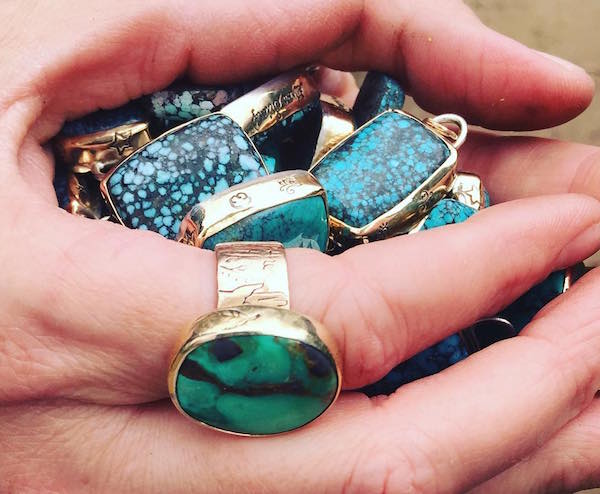
When you’re shopping for turquoise, it’s wise to inquire about treatments and—if you’re paying a significant price—request a guarantee of quality and origin.
I learned this the hard way many years ago when I bought a pair of “turquoise” earrings with large stones of a deep, classic turquoise blue webbed with convincing black veins. The stones (or whatever they were) faded to almost white within a year. To be fair, I paid very little for them. These days, I’d look askance at any turquoise jewelry with a price that low.
There’s not much richly-colored natural turquoise around any more. Imitations abound, including dyed organic material like coconut husks.
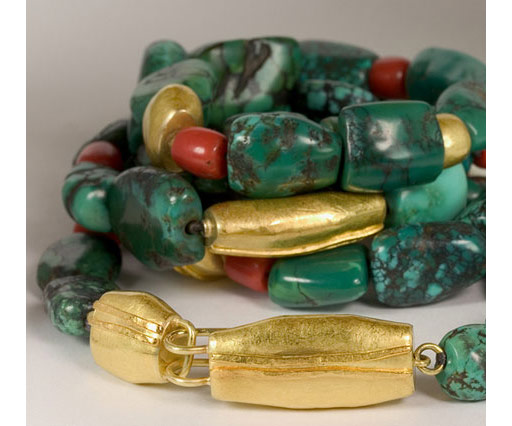 Turquoise, coral and 18kt gold necklace by Nancy Michel (Quadrum Gallery)
Untreated pure blue turquoise is particularly rare – especially the coveted sky-blue Persian variety – and that drives up prices and attracts knockoffs. Vivid blue stones from the famous Sleeping Beauty mine in Arizona are now so valuable they’re approached as precious gems, set with diamonds and gold like this ring by Larisa Laivins at Ylang 23.
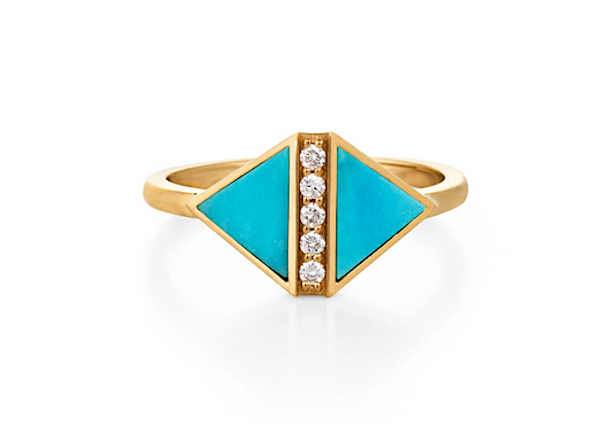 Ring by Larisa Laivins, handcrafted of 18k gold, Sleeping Beauty turquoise and diamonds
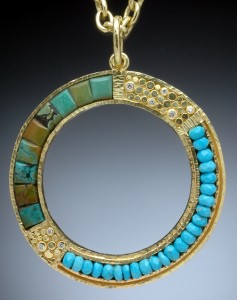 Hand-fabricated 18K gold pendant with inlaid Chinese and Sleeping Beauty turquoise and white diamonds by Hughes-Bosca
I actually love the less expensive mottled green Chinese turquoise webbed with black, and designers like Nancy Michel and Hughes-Bosca make luscious jewelry by contrasting it with gold, diamonds or purer blue varieties (pictured).
Treatments are common and sellers won’t always volunteer that information. If you ask though, a reputable dealer may admit their turquoise was stabilized, which is not necessarily bad if it improves the stone permanently and not just long enough to fool unsuspecting buyers.
The stones in the earrings I mentioned looked too substantial for the costume-jewelry price I was paying; that should have alerted me. But don’t be too paranoid. I’ve purchased several varieties since from various sources, and — unlike those cheap earrings I purchased long ago — all have held their color and finish. Ask for details about treatments. As with everything, they should be reflected in the price.
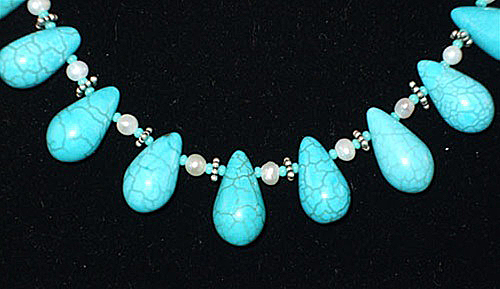 Necklace by Etania of stabilized turquoise ($175)
Common treatments for turquoise include colored-plastic impregnation, used to increase durability and turn whitish, porous stones blue. A similar process using wax instead of plastic can also change color and seal pores. Both can be detected with magnification, so use that loupe!
For more information
Designers featured here can be found at: Hughes-Bosca/Side Street Gallery, Mobilia, Jes MaHarry, and Ylang 23.
Background on the history and treatment of turquoise for this article came primarily from Gems & Crystals from the American Museum of Natural History and back issues of Lapidary Journal.
This book also comes highly recommended: Turquoise Mines, Minerals, and Wearable Art. If you’re looking for an up-to-date buying guide (2025), try Turquoise: Identifying and Collecting the Southwest’s Iconic Gemstone.