

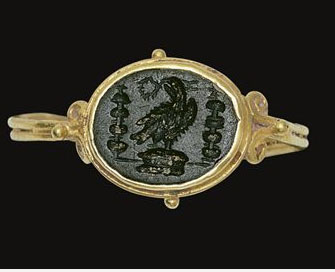
If you’ve never checked out the jewelry in Christie’s antiquities sales, you may be surprised to find that you can own a piece of ancient Rome or Greece – birthplace of some of the world’s finest gold work and gem carving traditions – for the price of a mass-produced designer bauble.
Antiquities in good condition are rare and that keeps prices high, but jewelry is a notable exception, says G. Max Bernheimer, international specialist and head of antiquities for Christie’s New York. “Items valued at less than $5,000 are not an aspect of the market that my firm focuses on, with the exception of ancient glass and jewelry.”
“Even though demand is very high, the supply is also surprisingly high. Not to say that something special won’t bring a big price.”
Many of the jewels in Christie’s antiquities sales are estimated at less than $5,000, and some wonderful ancient gold intaglio rings sell for as little as $2,000. “Ancient gold and beadwork are both very accessible,” says Bernheimer.
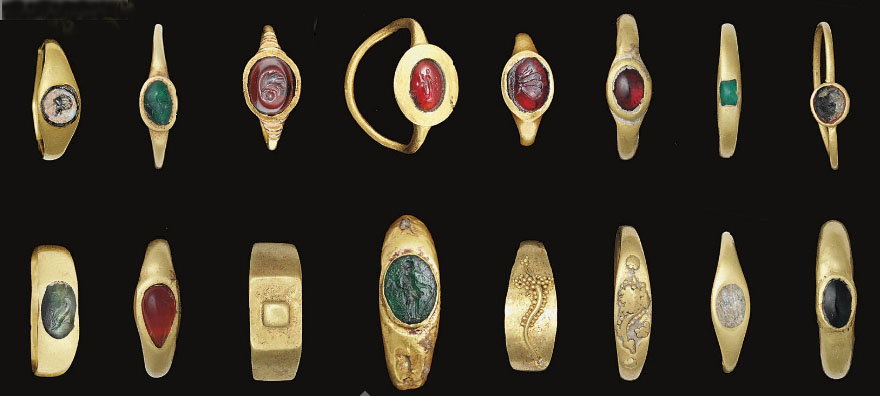
Why is ancient jewelry so affordable? “Like any market, this one is ruled by a simple equation of supply and demand,” Bernheimer says. “Even though demand is very high, the supply is also surprisingly high. Not to say that something special won’t bring a big price.”
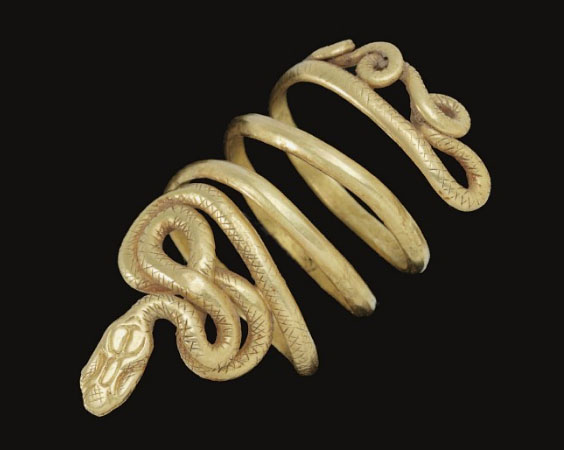
Surprise seller at Christie’s antiquities sale in December was a Roman gold snake ring that sold for more than five times the low estimate. Designed to wind halfway up a finger, this realistically sculpted and textured snake went on the block in The Year of the Snake Jewelry, when Brad and Angelina introduced their version at Asprey and celebs were popping up everywhere in jeweled serpents.
Made about 2,000 years ago with the crudest of hand tools, this old snake was the hippest of all. Estimated to sell for $3,000-5,000, it sold for $16,250 – proving, once again, that fashion trends can affect the jewelry market at every level, even antiquities.
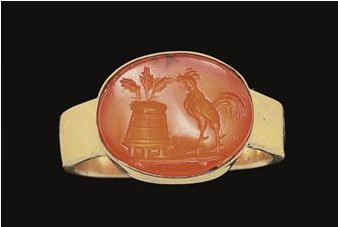
Exact origins can be difficult to determine with ancient jewelry. “Remember, jewelry is very portable and that was true in ancient times as well as now,” Bernheim says. “So things have always been on the move.”
There is no way to tell if a Roman gold finger ring was made in Italy or Spain, he says. In fact, there were about 40 countries where such a thing could have been found.
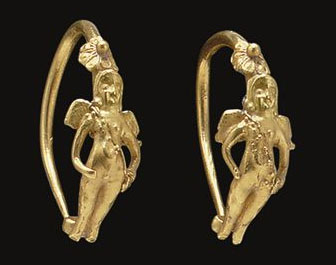
If you’re interested in collecting or reselling ancient gold jewelry, Bernheimer advises buying only from reputable sources and asking lots of questions. “My staff and I are always on hand during viewings and available for questions,” he says.
Collecting ancient jewelry, or any antiquity, can be tricky. “There are plenty of fakes and forgers and it takes some knowledge to wade through all of that,” Bernheimer warns. “Be wary of the Internet, particularly with antiquities and old jewelry.”
Related post:
What you need to know about collecting ancient jewels (according to Kenneth Lapatin, Getty Museum antiquities curator)
Related products:
Note: Buying through links on this site puts a couple bucks toward blog maintenance.